Fiber-coupled Diode Lasers
Definition: Fiber-coupled diode laser refers to a diode laser device that couples the generated light into an optical fiber.
Alternative term: pigtailed diode laser
More general term: diode laser
Category: Optical Fiber and Waveguide, Laser Equipment and Laser Physics
For many applications, it is convenient to couple the output of a laser diode into an optical fiber in order to transmit light where needed. Fiber coupled (also known as fiber integrated or fiber pigtail) diode lasers have the following advantages:
(1) The light leaving the fiber has a circular and smooth (uniform) intensity distribution and symmetrical beam quality, which is very convenient in many cases. For example, the optics required to generate a circular pump spot for an end pumped solid-state laser are less complex.
(2) The laser diode can be removed together with its cooling device, such as from the solid-state laser head, which can be more compact and leave more space for other parts here.
(3) Defective fiber coupled diode lasers can be easily replaced without changing the alignment of devices using light.
(4) Optical fiber coupling equipment can be easily combined with other optical fiber components.
Therefore, many diode lasers are sold in the form of fiber coupling, and solid fiber coupling optics (e.g. permanent laser welded fiber accessories) are built into the laser package. Different diode lasers use very different fibers and technologies:
(1) The simplest case is VCSEL (vertical cavity surface emitting laser), which usually emits beams with high beam quality, moderate beam divergence, no astigmatism and circular intensity distribution. A simple spherical lens is sufficient to image the emission point to the core of a single-mode fiber. The coupling efficiency can reach the order of 70-80%. The optical fiber can also be directly coupled (docked) to the transmitting surface of the VCSEL.
(2) Small edge emitting laser diodes are also emitted in a single spatial mode, so in principle, effective coupling with single-mode fiber is also allowed. However, if a simple spherical lens is used, the ovality of the beam will significantly reduce the coupling efficiency. In addition, the beam divergence angle is relatively high in at least one direction, and a lens with a relatively high numerical aperture is required. Another problem is the astigmatism of diode output, especially the gain guiding diode; This can be compensated by an additional weak cylindrical lens. The output power is up to several hundred milliwatts, and the fiber coupling gain guided LD can be used, for example, to pump erbium-doped fiber amplifiers.
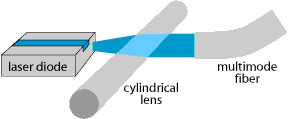
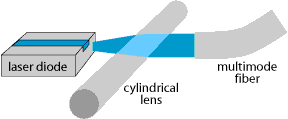
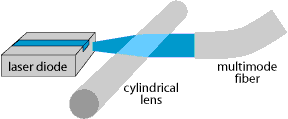
The large area laser diode is spatially multi-mode in the long direction of the transmitter. If the circular beam is simply shaped with a cylindrical lens (such as a fiber lens, see Figure 3), and then launched into a multimode fiber, a lot of brightness (radiance) will be lost, because the beam quality of the fast axis is very high. Unavailable. For example, a force of 1 W can be launched into a multimode fiber with a core diameter of 50 microns and a numerical aperture (NA) of 0.12. This is sufficient, for example for pumping low-power bulk lasers, such as microchip lasers. Even a transmission power of 10 W is possible.
An improved technique for wide-area lasers is to shape the beam before launching to obtain a symmetrical beam quality (not just a symmetrical beam radius). In this way, higher brightness can be obtained.
For diode bars (diode arrays), the problem of asymmetry in beam quality is even more serious. Here, the output of a single transmitter can be coupled into a separate fiber of the fiber bundle. The optical fibers are arranged in a linear array on one side of the diode bar, but in a circular array at the output end. Alternatively, some kind of beam shaper can be used to make the beam quality symmetrical before launching into a single multimode fiber. This can be done, for example, using a two-mirror beam shaper or some micro optics. It is possible, for example, to couple 30 W into a fiber with a core diameter of 200 microns (or even 100 microns) and NA of 0.22. Such a device can be used, for example, to pump Nd:YAG or Nd:YVO4 lasers with an output power of about 15 W.
For the diode group, an optical fiber with a larger core diameter is used. For example, it is possible to couple hundreds of watts (or even thousands of watts) of optical power into an optical fiber with a core diameter of 600 μm and NA=0.22.
Compared with free-space emitting lasers, some potential disadvantages of fiber-coupled diode lasers are as follows:
(1) Higher cost. However, this may be offset by the cost savings of simpler beam processing and transmission.
(2) The output power is slightly reduced, and more importantly, the brightness (radiance). The brightness loss may be large (more than an order of magnitude) or small, depending on the fiber coupling technology. In some cases, this may not matter, but in other cases, it presents significant challenges, such as the design of diode-pumped body lasers or high-power fiber lasers.
(3) In most cases (especially multimode fibers), the fiber cannot maintain polarization. Then, the fiber output is usually partially polarized, and when the fiber moves or the temperature changes, the polarization state changes. When pump absorption is related to polarization (for example, Nd:YVO4), this can lead to stability problems of diode-pumped solid-state lasers.
(4)It may not be possible to obtain fiber-coupled laser diode products for each light wavelength.
The beam quality of the fiber output is usually not specified; in many cases, only the core diameter and numerical aperture (NA) are known and assumed to be a step index multimode fiber. In this case, there is no equation for accurately calculating the beam quality, because it depends on the optical power distribution on the fiber mode, and this distribution itself depends on the launch conditions. However, the beam quality is unstable This factor can be roughly estimated, assuming that the power is uniformly distributed in each mode, so the numerical aperture represents a reasonable (maybe higher) estimate of the actual beam divergence. This brings up this equation. In this equation, a is the fiber core radius (that is, half of the core diameter). If the light is mainly emitted in a low-order fiber-guided mode, the beam quality will also be greatly improved, but then it may be reduced due to the strong bending of the fiber.